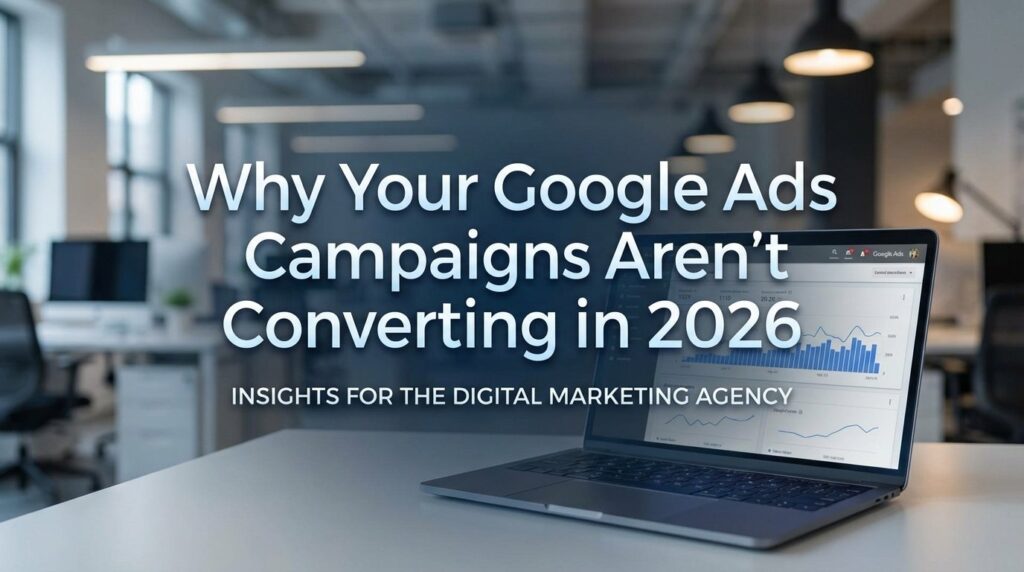
Why Your Google Ads Campaigns Aren’t Converting in 2026
You’re spending money on Google Ads every single day. The clicks are coming in, your dashboard shows activity, but when you look at your actual sales or leads? Crickets. If this sounds familiar, you’re not alone. In 2026, small business owners across South Florida are facing a frustrating reality: their Google Ads campaigns generate traffic but fail to deliver the conversions they desperately need.
The average google ads conversion rate across industries hovers between 3-5%, but many small businesses struggle to hit even 1%. That’s a lot of wasted ad spend. The good news? Your underperforming campaigns usually aren’t beyond saving. More often than not, they’re suffering from common, fixable issues that have nothing to do with your budget size.
Let’s dive into why your Google Ads aren’t converting and what you can actually do about it.
You’re Sending Traffic to the Wrong Landing Pages
This is the number one conversion killer we see when auditing small business ppc campaigns. Your ad promises one thing, but your landing page delivers something completely different. Or worse, you’re sending paid traffic straight to your homepage where visitors have to hunt for what they’re looking for.
Think about it from your customer’s perspective. They click an ad about “emergency plumbing services in Boca Raton” and land on your homepage with a generic welcome message and a menu of all your services. That friction between expectation and reality causes people to hit the back button instantly.
The Fix: Message Match and Dedicated Landing Pages
Every ad group should send traffic to a specific landing page that directly addresses the search intent. If your ad mentions “free consultation,” that phrase should appear prominently on your landing page. If you’re advertising a 20% discount, visitors should see that offer immediately upon arrival.
A Fort Lauderdale-based HVAC company we worked with increased their paid search ROI by 340% simply by creating dedicated landing pages for each service instead of sending everything to their homepage. Their google ads conversion rate jumped from 1.2% to 4.8% in just three weeks.
Your Keywords Are Too Broad
Broad match keywords might seem like a great way to cast a wide net, but in 2026’s competitive PPC landscape, they’re often conversion killers. Yes, you’ll get more clicks, but many of those clicks come from people who aren’t actually ready to buy or aren’t looking for what you offer.
When you target “shoes” as a broad match keyword for your boutique specializing in women’s dress shoes, you’re paying for clicks from people searching for running shoes, kids’ shoes, shoe repair, shoe storage solutions, and everything in between. That’s a recipe for google ads not converting.
The Fix: Refine Your Keyword Match Types
Focus on phrase match and exact match keywords, especially for service-based businesses with specific offerings. These match types give you better control over who sees your ads while still maintaining reasonable reach.
Layer in negative keywords religiously. If you’re a high-end wedding photographer in Miami, add terms like “cheap,” “free,” “DIY,” and “jobs” to your negative keyword list. Review your search terms report weekly and add irrelevant queries as negatives immediately.
You’re Ignoring Search Intent
Not all searches are created equal, and in 2026, Google’s AI has become incredibly sophisticated at understanding user intent. If you’re not aligning your campaigns with the different stages of the buyer’s journey, you’re burning money.
Someone searching “what is CRM software” is in research mode. Someone searching “best CRM for small business” is comparing options. Someone searching “HubSpot pricing” is ready to buy. These searchers need completely different ad copy, offers, and landing pages.
The Fix: Segment Campaigns by Intent
Create separate campaigns for informational, consideration, and transactional searches. Your informational campaign might offer free guides or blog content to build awareness. Your transactional campaign should focus on demos, quotes, and purchase-focused CTAs with stronger calls-to-action.
A Miami-based software company restructured their campaigns this way and saw their cost-per-acquisition drop by 62% while maintaining the same lead volume. The key was stopping the practice of showing “buy now” ads to people still in research mode.
Your Ad Copy Doesn’t Address Customer Pain Points
Too many small business Google Ads campaigns focus on features rather than benefits. “We have 24/7 customer service” is a feature. “Never worry about weekend emergencies again” addresses a pain point. See the difference?
In 2026’s crowded ad space, you have seconds to capture attention and demonstrate value. Generic ad copy like “Quality Services Since 2010” doesn’t cut it when competitors are speaking directly to what keeps your prospects up at night.
The Fix: Lead with Benefits and Use Emotional Triggers
Start by listing the top three problems your product or service solves. Then craft ad headlines that address those problems directly. Use emotional words that resonate with your target audience’s situation.
For a Delray Beach dental practice, we changed headlines from “Family Dentistry Services” to “Anxiety-Free Dental Care for Nervous Patients” and “Same-Day Emergency Appointments Available.” Their click-through rate increased by 89%, and more importantly, their consultation bookings doubled.
You’re Not Using Conversion Tracking Properly
This sounds basic, but you’d be shocked how many businesses run Google Ads without proper conversion tracking installed. Or they only track one type of conversion when they should be tracking multiple actions.
Without accurate conversion tracking, you’re flying blind. You can’t optimize what you can’t measure, and Google’s automated bidding strategies need conversion data to work effectively.
The Fix: Implement Comprehensive Conversion Tracking
Set up tracking for every valuable action: form submissions, phone calls, chat initiations, email clicks, and purchases. Use Google Tag Manager for easier implementation and maintenance.
Assign different values to different conversion types if appropriate. A phone call might be worth more than a newsletter signup. This helps Google’s algorithms prioritize the conversions that actually matter to your bottom line.
Your Bids and Budgets Don’t Match Your Goals
Many small businesses set Google Ads budgets based on what they can afford rather than what they need to spend to be competitive. Others spread thin budgets across too many campaigns, preventing any single campaign from gathering enough data to optimize effectively.
In competitive markets like South Florida, trying to run five different campaigns with $10 daily budgets each will almost always underperform compared to concentrating $50 into one well-optimized campaign.
The Fix: Strategic Budget Allocation
Start with your highest-converting campaign or the one targeting bottom-of-funnel keywords. Give it enough budget to run consistently throughout the day. Once that’s profitable, expand to additional campaigns.
Consider ppc campaign optimization through dayparting—running ads only during hours when your conversion rates are highest. A West Palm Beach law firm cut their ad spend by 30% while maintaining lead volume simply by pausing ads during hours when consultations rarely converted to clients.
You’re Not Optimizing for Mobile Users
In 2026, over 70% of Google searches happen on mobile devices, yet many landing pages still provide clunky mobile experiences. Slow load times, tiny buttons, and forms that require excessive typing kill conversions before they start.
Mobile users behave differently than desktop users. They’re often searching on-the-go, have less patience, and need information immediately. If your mobile experience doesn’t accommodate these behaviors, your google ads conversion rate will suffer dramatically.
The Fix: Mobile-First Optimization
Test your landing pages on actual mobile devices, not just responsive design previews. Ensure pages load in under three seconds. Use click-to-call buttons prominently. Minimize form fields—ask only for essential information.
Consider creating mobile-specific landing pages for high-value campaigns. A Boca Raton restaurant increased reservation conversions by 156% by creating a streamlined mobile landing page with a one-tap phone call button and simplified OpenTable integration.
You’re Neglecting Ad Extensions
Ad extensions increase your ad’s visibility, provide additional information, and generally improve click-through rates and conversion rates. Yet many small business ppc campaigns ignore them entirely or set them up once and never update them.
Extensions like callout extensions, sitelink extensions, and structured snippets give potential customers more reasons to choose you over competitors. They also take up more real estate on the search results page, making your ads more prominent.
The Fix: Maximize All Relevant Extensions
Enable every extension type that applies to your business. Use location extensions if you have a physical presence. Add call extensions for immediate contact. Create sitelinks to important pages like testimonials, pricing, and contact forms.
Update your extensions regularly to reflect current promotions, seasonal offerings, or new services. Treat them as dynamic elements of your campaigns, not set-it-and-forget-it features.
Your Offer Isn’t Compelling Enough
Sometimes the problem isn’t technical—it’s that your offer simply doesn’t stand out. In competitive industries, “contact us for more information” doesn’t motivate action. Your prospects need a compelling reason to choose you right now rather than continuing their research.
This doesn’t mean you need to slash prices or give everything away for free. It means you need to reduce the perceived risk of taking the next step with your business.
The Fix: Create Low-Friction Entry Points
Offer something valuable upfront: free consultations, no-obligation quotes, downloadable guides, or money-back guarantees. Make the first step in your relationship easy and risk-free.
A Fort Lauderdale landscaping company changed their CTA from “Schedule Service” to “Get Your Free Property Assessment ($200 Value)” and saw their conversion rate triple overnight. Same service, but the offer reframed the value proposition entirely.
Take Action on Your Google Ads Today
The gap between Google Ads campaigns that waste money and those that generate real paid search ROI often comes down to these fixable issues. You don’t need a massive budget to see results—you need strategic optimization focused on the fundamentals that drive conversions.
Start by auditing your campaigns against this checklist. Pick the three issues most likely affecting your performance and tackle those first. Track your results weekly and continue refining based on data, not guesswork.
If you’re a South Florida business owner tired of paying for clicks that don’t convert, UltraWeb Marketing specializes in turning underperforming PPC campaigns into lead-generation machines. We focus on what matters most—your bottom line. Ready to stop wasting ad spend and start seeing real results? Let’s talk about giving your Google Ads campaigns the attention they deserve.
Frequently Asked Questions
What is a good conversion rate for Google Ads in 2026?
The average google ads conversion rate varies by industry, but generally falls between 3-5% for search campaigns. Service-based businesses often see rates between 5-10%, while e-commerce typically ranges from 2-4%. However, what matters most isn’t hitting an industry benchmark—it’s whether your conversion rate delivers positive ROI for your specific business model and profit margins.
How long does it take to see results from Google Ads optimization?
Most ppc campaign optimization efforts show initial improvements within 2-4 weeks, with more substantial results appearing after 60-90 days of consistent testing and refinement. Google’s algorithms need time and conversion data to optimize delivery. Quick wins like fixing broken landing pages can show immediate improvements, while strategic changes like audience refinement take longer to demonstrate their full impact.
Should I pause my Google Ads if they’re not converting?
Not necessarily. Pausing campaigns that aren’t converting means losing the data and learning opportunities they provide. Instead, reduce budgets to minimize losses while you diagnose and fix the underlying issues. The exception is if you’re spending significant money daily with zero conversions—then pause, fix the fundamental problems, and relaunch strategically.
How much should a small business spend on Google Ads?
For small business ppc campaigns, start with a minimum of $30-50 per day per campaign to gather meaningful data. Your total budget should align with your customer lifetime value and acceptable cost-per-acquisition. A business with $5,000 average customer value can afford to spend more on acquisition than one with $200 transactions. Calculate your numbers first, then build budgets accordingly.
Can I manage Google Ads myself or should I hire an expert?
You can absolutely manage Google Ads yourself if you’re willing to invest time in learning and ongoing optimization. However, many small business owners find that working with specialists delivers better paid search ROI because experts bring experience across multiple accounts and industries. Consider the opportunity cost—is your time better spent managing ads or running other aspects of your business?